
Introduction
Modern websites rely more than just on application code to provide a secure and reliable user experience. Web servers, compression libraries, runtime environments, and third-party dependencies all play a role in how a website processes requests and delivers content.
A weakness in any of these components can cause a security concern, even if the website’s own source code appears to be functioning correctly.
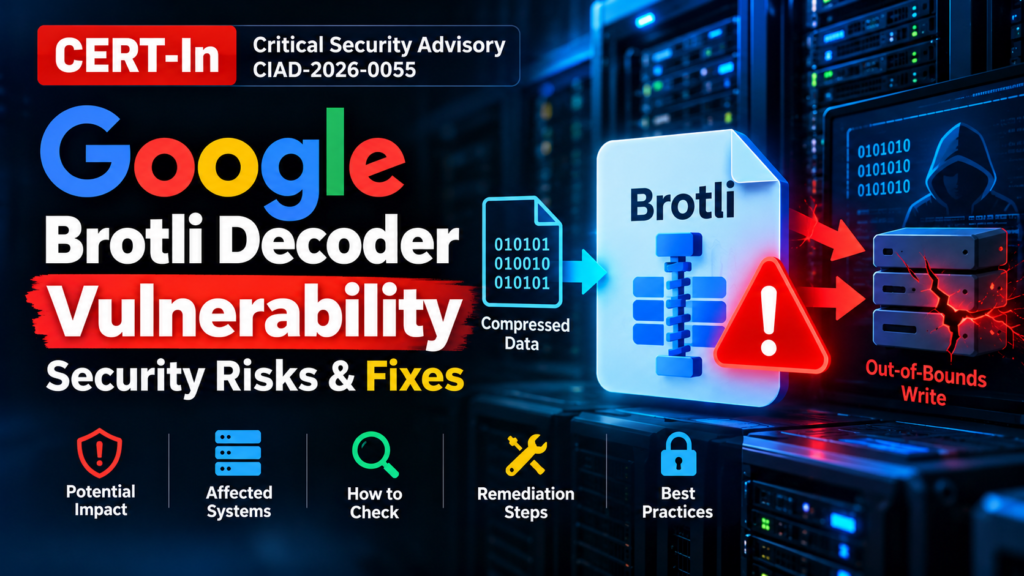
CERT-In advisory CIAD-2026-0055 addresses an Out-of-Bounds Write vulnerability associated with the Google Brotli Decoder. The issue highlights the importance of checking the software responsible for processing compressed data, rather than concentrating exclusively on application-level security.
For website administrators, the practical challenge is identifying whether an affected component is installed, understanding how it is used, and determining which security update applies to the environment.
This guide explains the underlying technology, the possible consequences of the vulnerability, and a structured approach to investigating and remediating the issue.
1. Understanding the Role of Brotli in Web Applications
Brotli is a compression technology developed by Google that helps reduce the size of data transferred over a network.
Web servers can use Brotli to compress text-based resources such as HTML, CSS, and JavaScript before delivering them to a browser. Smaller responses can reduce bandwidth consumption and improve loading performance, depending on the content and network conditions.
The process involves two main operations:
- Compression: Converting original data into a smaller representation.
- Decompression: Reconstructing the original data from the compressed representation.
The second operation is particularly relevant to this advisory. A decoder must correctly interpret compressed input while respecting memory boundaries and other processing constraints.
If the decoder contains a memory-handling defect, processing certain inputs may lead to unexpected behavior or security risks.
This is why compression libraries should be included in routine software inventory and vulnerability assessments.
2. What Does the CERT-In Advisory Highlight?
warning relates to an out-of-bounds write vulnerability found in the Google Brotli decoder.
An out-of-bounds write is a memory protection error that occurs when software attempts to write data outside the bounds of the memory allocated for that operation.
The vulnerability details should be recorded as follows:
| Field | Information |
| Advisory Reference | CIAD-2026-0055 |
| Component | Google Brotli Decoder |
| Vulnerability Category | Out-of-Bounds Write |
| CWE Classification | CWE-787 |
| Severity | Critical, as indicated by the advisory title |
| Security Concern | Memory corruption and potentially more serious exploitation, depending on the environment |
The actual impact on a specific server depends on the affected software, the installed version, the configuration, and the accessibility of the vulnerable processing path.
Therefore, any warning should be considered a reason for investigation, not proof that every system using Brotli has been vulnerable or is vulnerable to abuse.
Before making changes, administrators should confirm the applicable affected versions and remediation instructions in the original CERT-In warning and the relevant vendor documentation.
3. How Can a Memory-Boundary Error Affect Software?
Applications use memory to store information temporarily while performing operations such as parsing input, processing files, and decompressing data.
Software is expected to write only within the permitted memory region. When a programming error violates that boundary, information outside the intended region may be overwritten.
Consider a simplified example: a decoder reserves space for processing a compressed data block but, because of a defect, attempts to write more data than the allocated region can accommodate.
The consequences depend on the program’s memory layout and execution conditions.
Possible outcomes include:
- Unexpected application termination.
- Corruption of internal program data.
- Unstable application behavior.
- Potential security exploitation under certain conditions.
This example illustrates the general concept of an Out-of-Bounds Write. It is not a description of the exact exploit mechanism used against the Brotli vulnerability.
The central concern is that an error in a low-level library can affect the reliability and security of the application that depends on it.
4. What Security Risks Should Administrators Consider?
Memory corruption
A write beyond an allocated memory boundary can damage program data or internal state. This may result in unexpected behavior or a process crash.
Denial of Service
If specially crafted input causes a vulnerable service to fail, legitimate users may be unable to access the affected functionality.
The extent of disruption depends on the application architecture, error handling, and whether the failure can be triggered repeatedly.
Potential Remote Code Execution
Some memory-corruption vulnerabilities can be exploited to execute arbitrary code within a vulnerable process. Whether this is possible for a particular installation depends on the specific defect, execution environment, and available security protections.
Remote Code Execution should be treated as a potential impact where supported by the relevant advisory—not as an inevitable consequence of every installation.
Exposure of sensitive information
Depending on the implementation and exploitation conditions, memory-related defects may contribute to information disclosure. The actual impact must be assessed using the vendor’s technical guidance and available evidence.
These possibilities explain why administrators should investigate the issue promptly and apply the appropriate security updates.
5. Which Software Components Should Be Reviewed?
Brotli may be integrated into different products through native libraries, runtime packages, application dependencies, or infrastructure components.
A security assessment should consider the complete software environment, including:
| Environment | Areas to investigate |
| PHP applications | Runtime builds, extensions, and related dependencies |
| Node.js | Runtime version and vendor security updates |
| Python | Brotli-related packages and native dependencies |
| .NET | Applicable runtime and vendor security notices |
| Bun | Installed runtime and bundled components |
| Apache or other web servers | Enabled modules and compression-related configuration |
| Reverse proxies | Installed software, decoding behavior, and configuration |
| Containerized applications | Image contents, native libraries, and packaged dependencies |
The presence of one of these technologies does not automatically establish vulnerability. The relevant question is whether an affected component is present and whether the vulnerable functionality can be reached.
For this reason, a component inventory is more useful than making assumptions based on the programming language alone.
For PHP
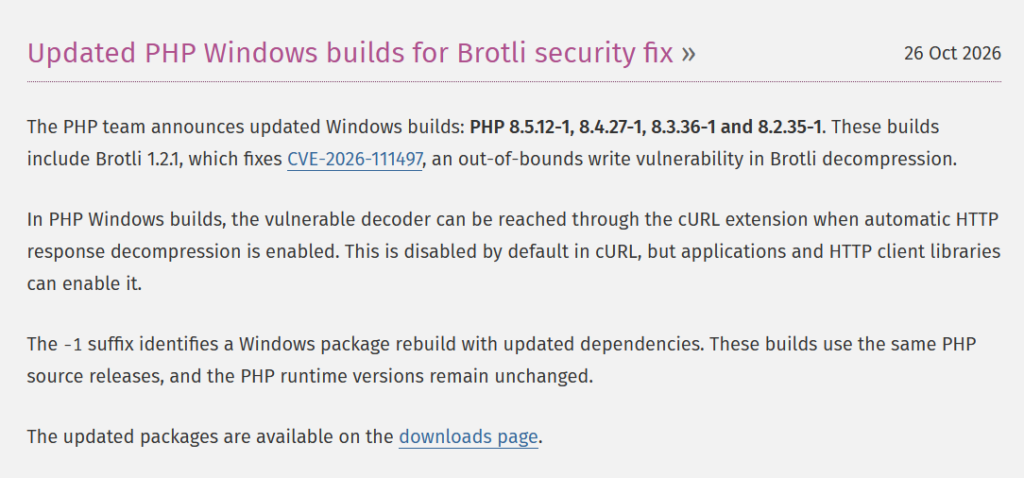
6. What Should PHP 8.3 and CodeIgniter 3 Administrators Know?
PHP and CodeIgniter administrators should distinguish between application-level vulnerabilities and vulnerabilities in supporting components.
CodeIgniter 3 is a PHP framework. The Brotli decoder issue does not, by itself, establish that the framework’s source code is defective.
However, a website built with PHP and CodeIgniter may rely on other components, including:
- PHP runtime packages and native extensions.
- Operating system libraries.
- Apache modules.
- Reverse proxies and content delivery infrastructure.
- Composer dependencies.
- Supporting Node.js or Python services.
- Prebuilt binaries or container images.
For example, a website’s PHP code may not directly call Brotli, while another component in the same structure uses the Brotli library to process data.
Administrators should therefore determine the actual location of the component before deciding which update to apply.
Important: A PHP version check alone cannot establish whether every Brotli-related dependency is affected or patched. Consult the relevant vendor’s security guidance for the specific runtime and package.
7. Initial Linux Checks for Brotli-Related Packages
The following commands can help administrators begin investigating a Linux server.
Check Debian or Ubuntu package records
dpkg -l | grep -i brotli
This searches installed package records for package names containing the term brotli.
Check RHEL-based package records
rpm -qa | grep -i brotli
Use this command on systems that use RPM package management.
Inspect PHP modules
php -m | grep -i brotli
This identifies loaded PHP modules whose names contain brotli. It does not identify every native library that PHP or another service might use.
Check the PHP CLI version
php -v
This displays the PHP version used by the command-line interface. The version used by Apache or PHP-FPM may differ, so verify the runtime serving the production website as well.
Review application dependencies
For a Composer-managed application, the following command can help inspect installed dependencies:
composer show
Review the output for relevant packages and investigate their dependency requirements.
These commands are intended for initial inventory, not as definitive vulnerability scanners. A negative result does not prove that the server is unaffected. Some components bundle their dependencies, use different package names, or operate inside containers.
The final assessment should include the relevant vendor package information and deployment configuration.
8. A Practical Remediation Process
Once a potentially affected component has been identified, follow a controlled remediation process.
Step 1: Confirm the security finding
Review the original CERT-In advisory and the security notice published by the software vendor.
Record the advisory identifier, component name, applicable versions, and recommended corrective action.
Step 2: Establish the installed version
Identify the exact package or build running in the affected environment.
Where possible, record the package source, installation method, and any vendor-specific version information.
Step 3: Determine the correct security update
Apply the update recommended for the affected product.
Do not assume that all software products use the same version numbering or release process. Some vendors incorporate fixes into maintained packages without using the same version number as the upstream project.
Step 4: Validate the change in staging
Before production deployment, check the functionality that depends on the updated component.
Testing should cover normal website navigation, login, form submissions, API calls, compression behavior, application logs, and relevant integrations.
Step 5: Deploy through change management
Use the organization’s approved deployment process. Preserve the relevant configuration and schedule the update to minimize disruption.
Restart affected services only when required by the package or vendor instructions.
Step 6: Verify the final state
After deployment, confirm that the intended package or build is installed and that the application is operating normally.
Retain the verification results so that the remediation can be reviewed later.
9. Is Disabling Brotli a Suitable Temporary Measure?
Disabling Brotli is not automatically required for every environment.
This may reduce performance benefits, and changing compression settings may not resolve the issue if vulnerable decoders are being used elsewhere in the infrastructure.
If a component is confirmed to be affected and an immediate update is not available, administrators should evaluate temporary solutions recommended by the vendor.
The assessment should determine:
- Which service performs the decoding.
- Whether untrusted compressed data can reach that service.
- Whether a targeted configuration change can reduce exposure.
- What effect the change will have on application functionality.
- When the permanent security update can be applied.
Any temporary mitigation should be documented and reviewed until the permanent fix has been verified.
10. Security Audit Checklist
Use this checklist to manage the finding across development, infrastructure, and security teams.
- Review the original CERT-In advisory.
- Record the advisory and relevant vulnerability identifier.
- Inventory Brotli-related libraries and dependent software.
- Identify the exact package and installed version.
- Confirm the applicable vendor security guidance.
- Prioritize affected services exposed to untrusted input.
- Apply the recommended update or temporary mitigation.
- Test the change in staging.
- Verify the production deployment.
- Preserve supporting evidence and change records.
- Track any unresolved exposure until closure.
For organizations that undergo security audits, the final report should clearly explain what was affected, what action was taken, and how the result was verified.
11. Frequently Asked Questions
Does using Brotli automatically make a website vulnerable?
No. The presence of Brotli alone does not establish that a website is affected. Administrators must identify the component, check its version, and determine whether the vulnerable functionality is relevant to their environment.
Is a PHP 8.3 upgrade sufficient to resolve the issue?
Not necessarily. The correct action depends on the component affected in the particular deployment. PHP, the operating system, the web server, and other services may require separate assessment.
Is CodeIgniter 3 responsible for this vulnerability?
The advisory identifies a Brotli decoder issue. It does not, by itself, demonstrate a defect in CodeIgniter 3. A CodeIgniter application may still depend on affected software elsewhere in its environment.
Can a security scanner confirm that the issue is fixed?
A scanner may identify software versions or configuration risks, but its findings should be compared with the vendor’s security guidance. Version verification and appropriate post-update testing provide additional evidence.
What should be included in the closure report?
Record the affected component, installed version, advisory reference, applied remediation, deployment date, test results, and supporting evidence.
Conclusion
The Google Brotli Decoder security advisory highlights an important lesson for website administrators: protecting an application requires attention to the entire software stack, not just the source code.
A vulnerability in a supporting library may introduce risk even when the primary application appears to be working correctly. The appropriate response is to identify the affected component, confirm the applicable vendor guidance, apply the required security update, and verify the outcome.
For PHP 8.3 and CodeIgniter 3 deployments, this means examining the runtime, operating system packages, web server, dependencies, and supporting infrastructure rather than relying on the framework version alone.
A documented and carefully tested remediation process helps organizations reduce exposure, maintain service availability, and provide reliable evidence during security audits.
Official References
- CERT-In advisory CIAD-2026-0055: https://www.cert-in.org.in/s2cMainServlet?VLCODE=CIAD-2026-0055&pageid=PUBVLNOTES02
- Google Brotli repository: https://github.com/google/brotli
- MITRE CWE-787 — Out-of-bounds Write: https://cwe.mitre.org/data/definitions/787.html
- PHP official website: https://www.php.net/
Disclaimer: This article is intended for technical awareness and educational purposes. Verify the original advisory and the applicable vendor security notice before changing any production system.